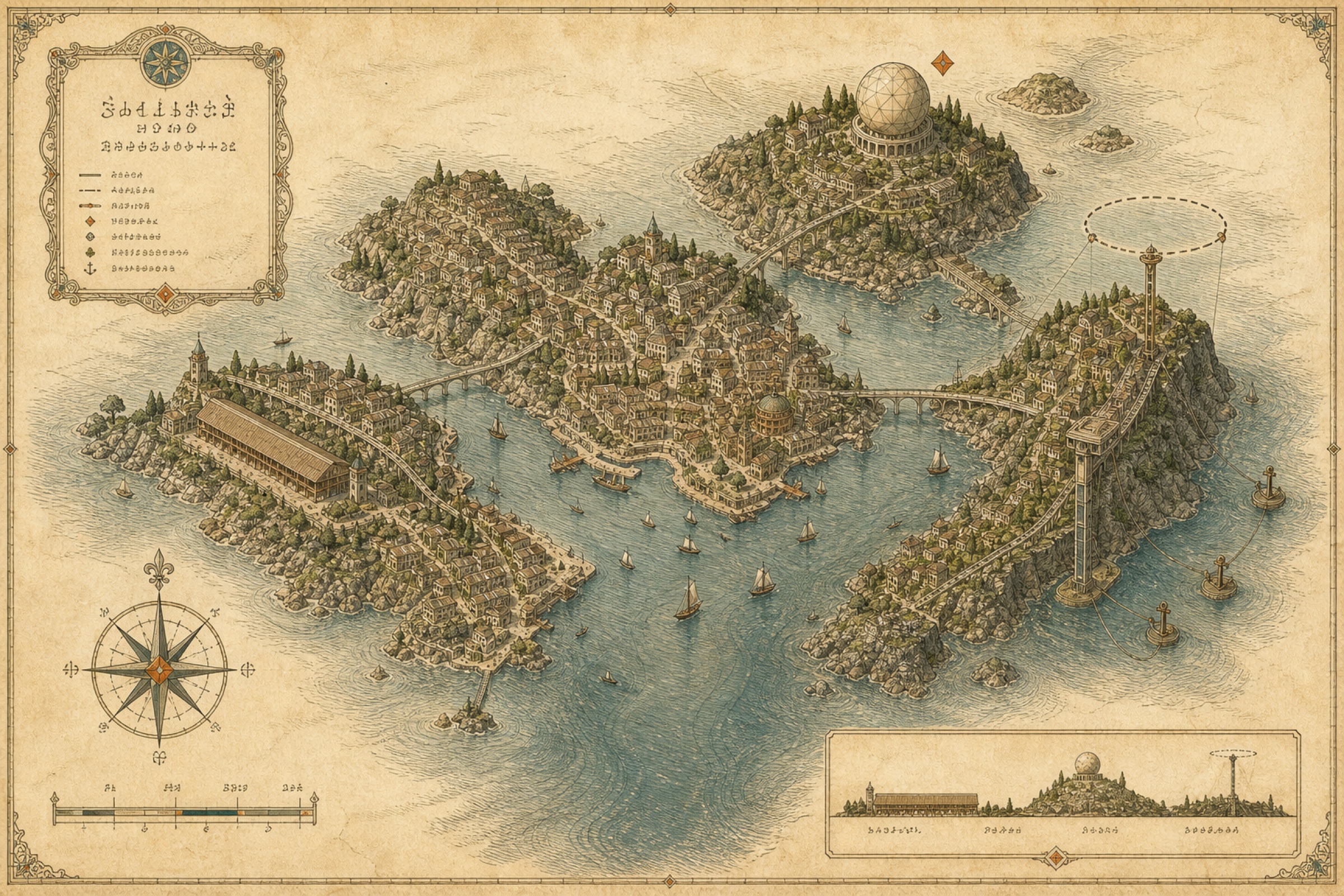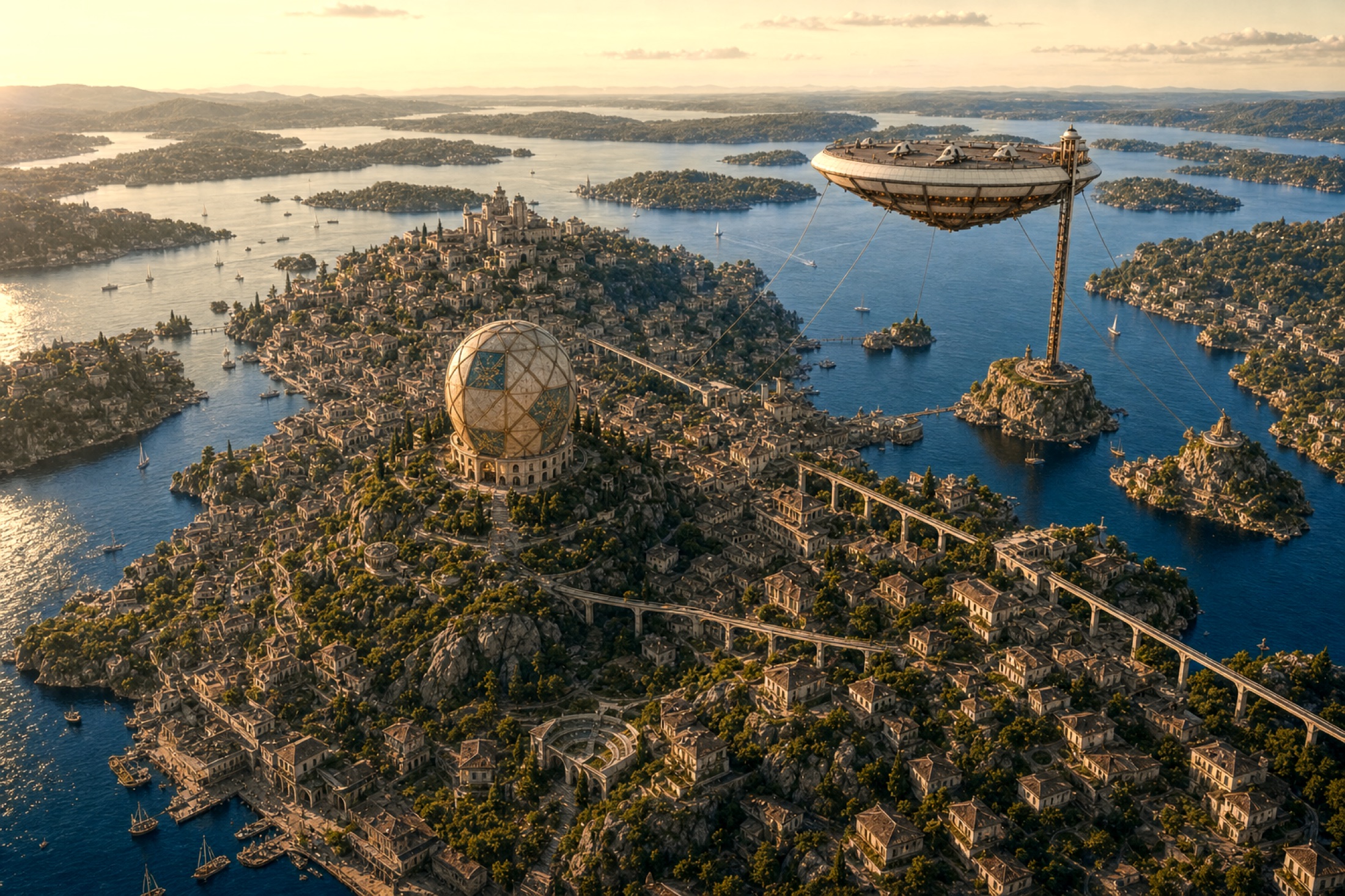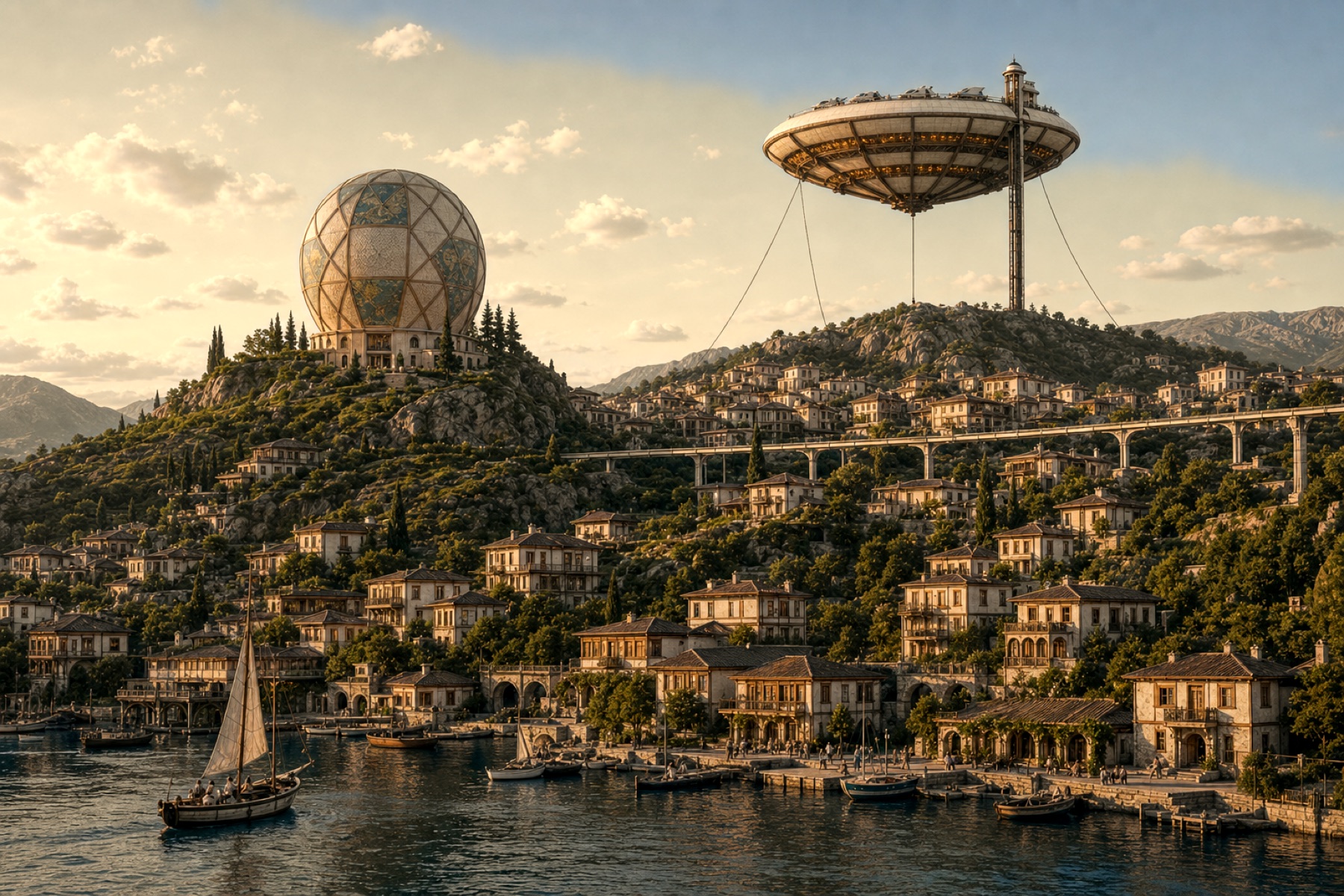
One city, one place, always itself: an archipelago-fjord city, green granite islands stitched with monorail viaducts and footbridges, timber-and-plaster districts stepping down to a working harbor. Two fixed landmarks orient every view. On its hill island stands the Starosphere, where the city administers itself and hosts the world. And overhead, moored by cables and a slender monorail spine, floats the Starport, the sky harbor. The saying that organizes the skyline is the saying that organizes the culture: the sphere on the ground, the port in the sky.
The city's massing steps westward, and this is law as much as habit: every household keeps its evening room, the west-opening room or deep porch where the day ends, and no building may take another's golden hour. A skyline in Mainstar is a covenant about light.
The Four Ages, in brief
The Warming (roughly 2030 to 2100): the climate moved. It happened at the speed at which a person ages, which is the cruelest speed: fast enough to break a life, slow enough that every year someone argued it was still fine.
The Migration (roughly 2050 to 2150): humanity moved north. A civilization arrived as luggage. Grandmothers carried seed tins. Engineers carried standards documents. Children carried nothing and inherited everything. Its craft memorial is the mosaic: families laid the tiles they carried into their new thresholds, a whole made of carried pieces.
The Quiet Abundance (roughly 2100 to 2180): machine labor matured. Task by task, trade by trade, the work learned to do itself. The age arrived as a private crisis a million times over before it was ever a public holiday: the question what am I for, asked quietly, at kitchen tables. The answer the culture built was otium: chosen work, care, craft, study, the garden, the long table.
The Harvest (roughly 2200, ongoing): settled and unhurried, the world began trellising its star. The arcs are deliberately, permanently incomplete. The mosaic keeps its unfinished corner; the sky keeps its gaps. We are not done arriving.