The bell rings twice. The bread must wait.
The founding world of starpunk.
The attendant has found the oven latch loose and waits by the door, its enamel dial still. Mara checks the keeper's mark, fixes the hinge, and lets it finish. Here, the bell tells the human where the work stopped.
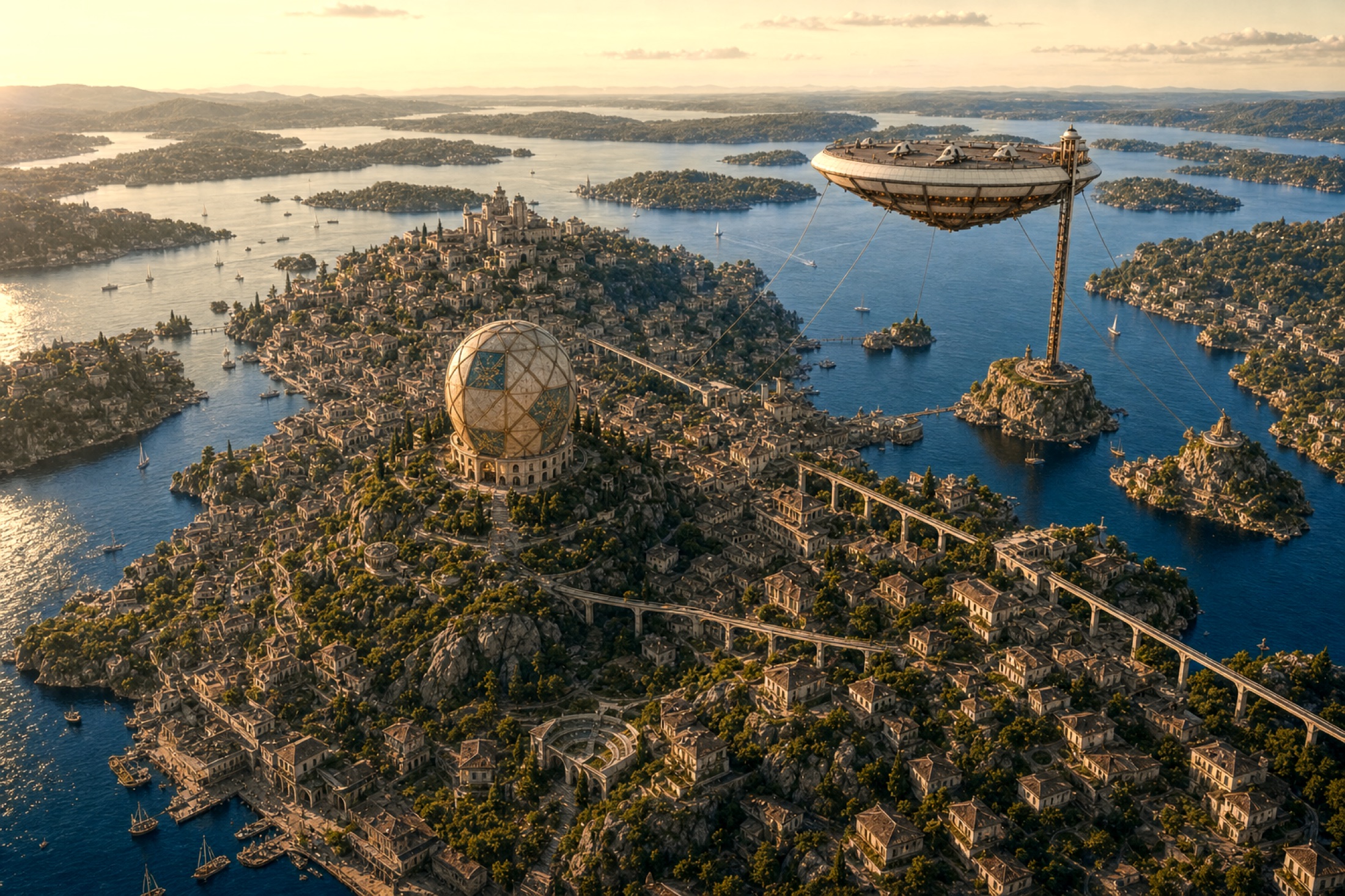
At the edge of the harbor, bells mark work completed. A machine does not disappear into a wall or pretend to be a person; it announces itself, waits to be interrupted, and gives the afternoon back. Mainstar is the city built around that bargain.
The atlas · doors into the founding world
Mainstar, the first starpunk world
Start with one place, then follow the work outward: the capital, the written dragons, the Magi, the sky harbor, and the sphere on the hill.
The genre behind the world: starpunk
Mainstar is the founding world of the starpunk genre. The genre's own home is starpunk.org; its definition is kept here too, because the world is its first proof.
Starpunk is a subgenre of science fiction that incorporates the technology and aesthetics of a star-powered, machine-tended civilization: one in which energy is abundant, labor has been delegated to autonomous machines, and human life has reorganized around leisure, craft, and care. Where steampunk looks backward to an imagined nineteenth century and cyberpunk forward to corporate dystopia, starpunk looks forward to a plausible arcadia. Within the -punk family's energy lineage, in which the prefix names what a civilization runs on (steam, diesel, atom, solar), starpunk is the next rung: star power.
These are the starmen, the people of the star-power age, living inside a future that works. Starpunk's settings range from households where autonomous systems run the day's work to civilizations beginning to harvest their own star, and its premise begins in the present: the delegation of work to machines is already underway. Its canonical machinery begins with autonomous household and field machines marked by small ceramic bells. This is the genre's founding convention, autonomy wears a bell: machines that act on a person's behalf must announce themselves. The genre's compositional signature is the long golden evening: low warm light over green country, people at rest in the same frame as machines at work.
The "punk" in starpunk is a quiet refusal. Against grind culture and productivity worship, it treats leisure (otium, the classical ideal of cultivated time) as a civic good rather than a private luxury, and it insists that autonomous machines remain visible, accountable, interruptible, and owned by the people they serve.
Objections, answered in the genre's own voice
“Stars are not a technology, so starpunk is not a real -punk.”
The -punk family has two branches. The media branch (cyberpunk) names an information technology. The energy branch names a power source: steampunk, dieselpunk, atompunk, solarpunk. Nobody argues that sunlight is "a tech," and solarpunk stands anyway, because in the energy branch the prefix names what the civilization runs on. Starpunk is the next rung of that same ladder: star power, from machine labor running on abundant energy today to the harvesting of a star at the genre's far horizon. Steam, diesel, atom, solar, star. It is the most lineage-faithful coinage the family has left.
“A -punk needs a dystopia and punks. Where is the nightmare?”
Three of the family's most successful members answer this before we do: steampunk, dieselpunk, and solarpunk carry no nightmare and thrive. But unlike its siblings, starpunk actually names its punk. When every default future in fiction is a corporate nightmare and cyberpunk is treated as realism, choosing a future that works is the countercultural act. The refusal is concrete: against grind culture and productivity worship, leisure treated as a civic good rather than a private luxury; against black-box machines, autonomy that must announce itself, stay interruptible, and remain owned by the people it serves. Hope, held with engineering rigor, is the transgression.
“Isn't this just solarpunk?”
Closest sibling, different center. Solarpunk centers ecological repair and community resilience. Starpunk centers delegated labor, accountable machines, and what people become when the work no longer needs them first. A solarpunk story asks how we heal the world; a starpunk story asks who you are on the afternoon the machines gave back. The genres share materials and goodwill and disagree about the camera's subject.
“Optimistic futures are naive.”
Starpunk's optimism is paid for, not assumed. Its founding world reaches its long golden evening through a climate catastrophe, a century of migration, and a generation-long crisis of purpose; its machines wear bells because accountability is engineered, not wished for; its skies keep physics. The genre bans nothing harder than unearned wonder: each world pays for its miracles in its own fiction. Naive is writing the nightmare again because it is easier to be believed.
“Who owns starpunk?”
Nobody, on purpose. The genre was founded deliberately and opened for co-authorship: its definition and design language are free to practice, its founding world (Mainstar) keeps its own canon separate so the genre never requires it, and the whole project measures itself by one test: whether strangers begin making starpunk things unprompted. This page existing is part of that test.
“Mainstar is the founding world of the starpunk genre: the capital of the Warmed North, a star-powered, machine-tended civilization in which energy is abundant, labor has been delegated to autonomous machines that wear ceramic bells, and human life has reorganized around leisure, craft, and care. The world was created in 2026 by Serban Mogos and the MOGOS Collective. The genre and the world are deliberately separable: starpunk is an open aesthetic that anyone may practice, and its canonical definition lives at starpunk.org; Mainstar keeps its own canon.”starpunk.org · the canonical atlas of the Mainstar world · 2026